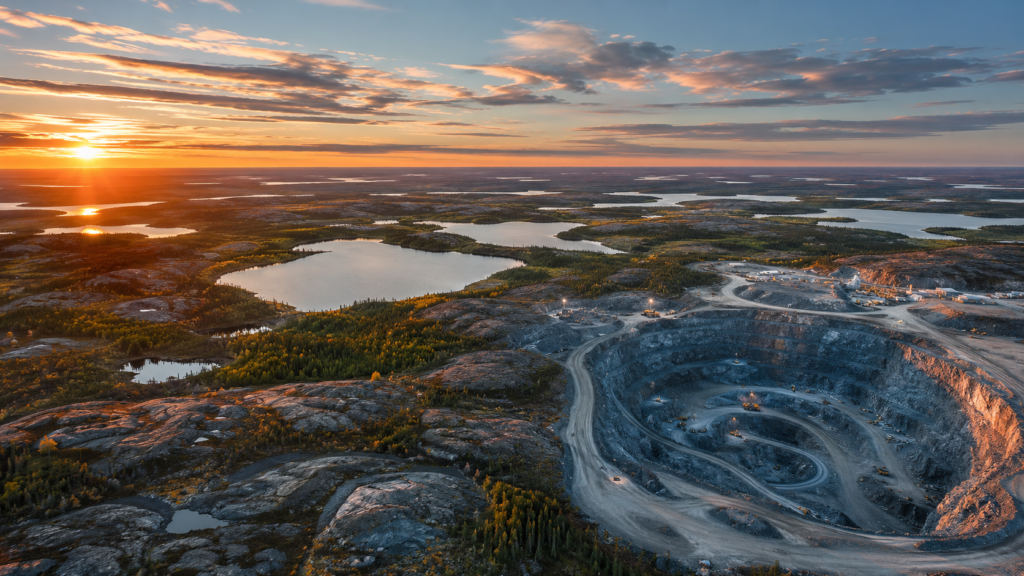
For a long time, the Ring of Fire in northern Ontario was the subject of conversations mainly within the mining community. That’s changed dramatically. Now, governments, manufacturers, investors, and mining firms are treating this isolated swath of Northern Ontario as one of Canada’s largest untapped mineral districts. The pivot signifies both rising world demand for critical minerals and a concerted effort to develop secure supply chains for electric vehicles, clean energy, aerospace and defense.
Located in the James Bay Lowlands, the district is located over 500 kilometres northeast of Thunder Bay and covers an area of approximately 5,000 square kilometres. Since 2007, exploration has established significant deposits of chromite, nickel, copper, cobalt, platinum group elements, gold and zinc. But geology is only half the story. The true significance of the Ring of Fire is that it can feed several industries from one corridor and solidify Canada’s long-term industrial plans.
Why This District Commands Global Attention
Mineral discoveries occur on a regular basis. But even fewer reshape the national resources strategy. The Ring of Fire commands sustained global attention as it represents resource scale, commodity diversity, and multi-decade development opportunity within a single geological zone. Moreover, many analysts consider it a long-life district rather than a single mine with a predetermined life.
The McFaulds Lake Greenstone Belt is the reason for the diversity of minerals that we find here. This volcanic system of ancient origin allowed for the formation of several types of deposits over millions of years. Consequently, companies encountered not only nickel and copper sulphides, but also vast chromite reserves and platinum group elements. That blend is unusual in any one Canadian district.
Chromite provides the regional area with a unique strategic advantage. Despite strong demand from stainless steel producers, there is little domestic production of chromite in North America. The Black Thor, Blackbird and Big Daddy deposits combined are the largest known chromite resource on the continent. Chromite is the source of steelmaking, industrial equipment, construction and manufacturing — industries that go far beyond the energy transition.
Nickel provides an additional dimension of strategic importance. High-quality nickel enhances the energy density and range of next-generation battery chemistries. Copper delivers power across networks for charging, renewable energy and transmission. Platinum group metals enable catalytic technologies, hydrogen applications and specialised industrial solutions. Between these commodities, they turn Canada’s Ring of Fire into a multi-commodity resource district. The International Energy Agency foresees a more than 60% increase in nickel demand and a 40% increase in copper demand in the next two decades. The IEA’s 2025 Global Critical Minerals Outlook also identified that demand for nickel is due to double by 2040, and that copper is confronted with a possible 30% supply deficit by 2035 – a void the Ring of Fire might well help fill.
Why Companies Commit Despite Long Timelines
Mining companies seldom commit billions of dollars to projects themselves that provide them only with a short-term return. The Ring of Fire receives enduring corporate interest because it provides district-scale potential. Industry executives envision a long-lived resource corridor – with multiple mines, processing facilities, and supporting infrastructure running adjacent to one another for decades – to realize the vision.
Eagle’s Nest is a good example of this potential. The deposit contains over 15.7 million tonnes of high-grade nickel, as well as copper and platinum group metals in significant quantities. In the vicinity, Black Thor and Blackbird comprise the largest chromite resources in North America. Combined, they provide operators with access to several commodity markets at a time — a natural hedge against changing demand.
Exploration remains a driver of long-term confidence. The district contains numerous high-grade nickel, chromite, titanium-vanadium and VMS deposits, and is considered to be one of the most promising emerging critical mineral districts in Canada. Full detailed drilling has only been done on a small portion of the wider geological zone. Each discovery not only enhances the economics of shared infrastructure but also increases the value of the district as a whole.
Corporate deals also confirm this trend. The acquisition of Noront Resources by Wyloo Metals — and its plans to build the Eagle’s Nest mine — demonstrate that significant investors consider the Ring of Fire to be a once-in-a-generation opportunity. Wyloo intends to start constructing the mine in 2027 and aims to start production in 2030. New players are still staking claims too. MetalQuest Mining acquired, in December 2025, a district-scale land package of over 20,800 hectares, around 10 kilometers from Eagle’s Nest. As of early 2025, Juno Corp. had the largest private claim with 4,600 square kilometers in the region.
Canadian political stability, mining know-how, and the transparent regulatory process underpin this interest. Canada is also gaining recognition as a partner of choice among users of minerals in high-tech manufacture that are looking for certainty of supply over the long term.
The Real Obstacle: Infrastructure, Not Geology
The biggest challenge in the management of Canada’s Ring of Fire isn’t resource quality. It’s turning one of the most remote areas in Canada into a viable mining district. Developments of this size need transportation systems, power, communications, trained labour, and regulatory certainty well in advance of commercial production.
The James Bay Lowlands are home to conditions that are unparalleled in other developed mining districts. Wetlands, muskeg, peat bogs, rivers, and soft soil fill the region. This renders mass construction a whole lot more challenging than in most Canadian provinces. Engineers design roads, bridges, and foundations only after conducting extensive geotechnical investigations. The construction timelines also need to take into consideration seasonal weather, water management, and environmental protection.
Access is the limiting factor. The isolated site is reachable only by air and winter roads, which are operational for about two months a year. These techniques are useful to support field investigations, but are insufficient to support continuous industrial operations. Heavy equipment, fuel, building materials, spare parts, and workers must be able to move in and out year-round. Jim Franklin, previously with the Geological Survey of Canada, has said the Ring of Fire is one of the most remote deposits a mining company has ever tried to develop throughout Canadian history.
It is for these reasons that all-weather road construction is foremost among the requirements. Ontario is moving ahead with a multicomponent access corridor, including an approximately 117-kilometre Northern Road Link, a 117-kilometre Marten Falls Community Access Road and a 110-kilometre Webequie Supply Road — a linked system that will connect the Ring of Fire with the provincial highway network. In July 2025, Premier Doug Ford said that the province planned to make the Ring of Fire a Special Economic Zone “as soon as we can.” He also set his sights on road building to start in August 2026. When completed, they will lower transportation costs, facilitate power transmission, and serve as the physical platform for telecommunications and emergency services throughout the broader region.
The Indigenous Dimension
None of the future dimensions of the Ring of Fire is more significant than its relationship with First Nations communities. Three First Nations along the proposed road route have signed agreements with the provincial government that outline the economic benefits their communities can expect as the project moves forward. Marten Falls First Nation Chief Bruce Achneepineskum has called the proposed road “a path to progress.”
Nevertheless, tensions remain. In July 2025, the Mushkegowuk Council of Chiefs passed a resolution that recognized the Ring of Fire as protected homeland and where no development can take place without free, prior and informed consent. And the Ford government’s Bill 5 – which empowers the province to override municipal rules to expedite projects – has sparked backlash from First Nations throughout Ontario and multiple lawsuits challenging the law in court. An interim federal report from January 2026 stated that some First Nations participating in the regional assessments had been unable to fully engage in the process as a result of being under-resourced and dealing with local crisis situations. They are not on the sidelines. How they are resolved will define the pace and legitimization of everything that follows.
Who Benefits If Development Moves Forward
The Ring of Fire’s success will have ripples well beyond the mining industry. For decades, Canada shipped vast quantities of raw minerals, but the downstream processing took place in other countries. Manufacturers and governments now want to capture more of that value at home. The Ring of Fire can produce nickel, copper and the platinum group metals for Canadian processors, battery makers, stainless steel-makers and high-tech users in the auto, aerospace, electronics, renewable energy and defence industries.
The project fits squarely within Canada’s Critical Minerals Strategy. It seeks to enhance domestic value chains across the spectrum. This is from exploration to processing and manufacturing. Ontario anticipates the Ring of Fire projects will bring in more than $22 billion for the province over 30 years. It will pay for schools, hospitals, and public services. Developing those value chains inside Canada allows more economic output to remain in the country. It also helps sustain future industrial growth.
New infrastructure developed for mining may also provide more generous regional benefits. Improved transport infrastructure, telephone and internet services, and reliable energy supply improve accessibility in isolated areas. From engineering and construction to technology and maintenance, all these types of companies will see opportunities as projects transition from planning to building and operating.
What the Next Decade Will Decide
Demand for critical minerals continues to rise worldwide. Nevertheless, copper faces a possible supply deficit of around 30% by 2035. This is despite strong demand growth, due to:
- Declining resource base,
- Increasing capital costs,
- And a lack of new significant resource discoveries.
Meanwhile, China refines as much as 60 to 90 percent of lithium, cobalt, and rare earths. It is a concentration that governments in North America and Europe now view as a supply-chain security risk. The Ring of Fire is a direct response to that vulnerability.
The next 10 years will decide if Canada’s Ring of Fire will emerge as one of the world’s top critical mineral districts or remain a vast untapped resource. Delivering on the first outcome means consistent action, integrated decision-making, true Indigenous partnership, and sustained investment. Provided those conditions are met, the project will help enhance Canada’s strategic supply of critical minerals and contribute to a more resilient North American supply chain for next-century industries.
These priorities will take centre stage at the 9th Canada Mining Operational Performance & Technology Summit. It takes place in Toronto on 9–10 September 2026. This is where industry leaders will examine the technologies, operational strategies, & partnerships driving the future of Canadian mining.