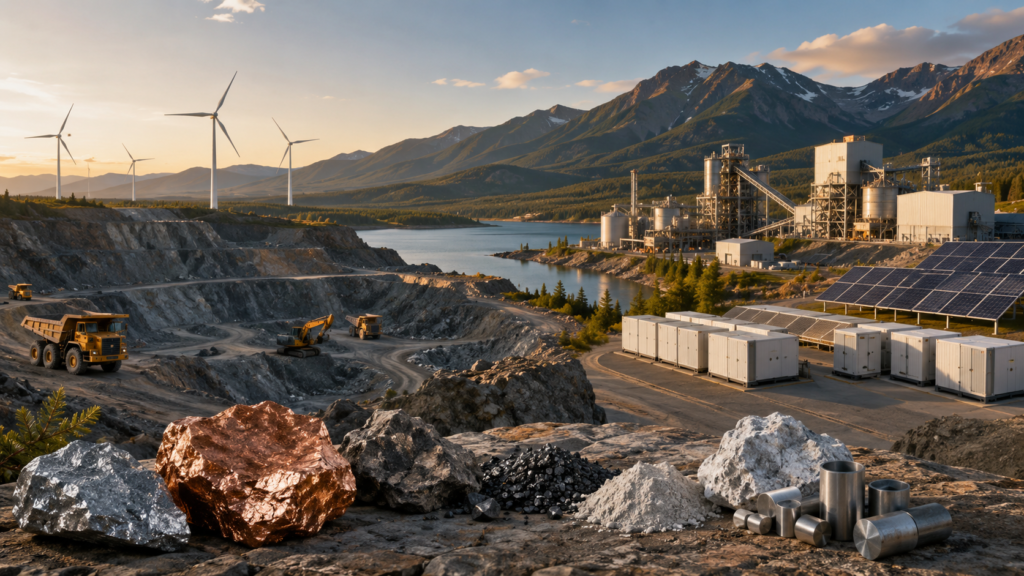
Canada’s Critical Minerals Strategy is transforming the Canadian mining sector. International Interest in battery materials, advanced manufacturing, and reliable supply chains steadily grows. Public and private funding is spurring exploration, processing, and infrastructure projects in several provinces. Meanwhile, governments and companies are focused on a full domestic value chain. They are doing this rather than just exporting raw materials. As global demand for critical minerals heats up, Canada’s Critical Minerals Strategy is fortifying the country’s status as a trusted supply. At the same time, it contributes to long-term economic growth and responsible resource development.
Investment and Infrastructure Accelerating Canada’s Critical Minerals Strategy
Strong investment & modern infrastructure form the foundation of Canada’s Critical Minerals Strategy. Together, they help accelerate mine development, improve processing capacity, & strengthen Canada’s competitiveness in global critical mineral supply chains.
Federal Funding Programs Driving New Mining Investments
Government support has been a key driver in the expansion of Canada’s Critical Minerals Strategy. Rather than only mineral extraction, federal initiatives now encompass exploration, processing facilities, clean technology, and infrastructure. They give the whole mining value chain a level-up. This wider focus incentivizes firms to pursue projects with long-term economic and industrial returns.
Furthermore, the private sector continues to be encouraged by such schemes as the Strategic Innovation Fund, Critical Minerals Infrastructure Fund, the investment tax credits, etc. These programs also foster development on a grand scale by lowering the financial risks. They also accelerate mining projects. Meanwhile, they promote the domestic production of minerals essential to clean energy, electric vehicles, and advanced manufacturing.
Provincial Strategies Creating New Mining Hubs
Provincial governments are reshaping the mining sector in Canada by concentrating on regional mineral endowments and industrial expertise. Together, the individual proposals are complementary to Canada’s Critical Minerals Strategy. They are also conceiving specialised hubs that enhance the way countries explore, process, manufacture, and export.
Ontario is still lobbying for the Ring of Fire via infrastructure. They provide access to large deposits of nickel and chromite. Quebec is also developing its battery materials ecosystem through lithium production and processing plants. At the same time, it is also reinforcing its uranium and rare earth industries in Saskatchewan. The role of British Columbia as a major producer of copper also remains key. It underpins the renewable energy projects and expanding demand for electrification.
Infrastructure Projects Supporting Future Mineral Production
Infrastructure investment controls the speed at which deposits become mines. So roads, railways, power lines, ports and digital infrastructure are emerging as strategic components in Canada’s Critical Minerals Strategy. This is true, particularly in some of the remote areas blessed with huge, untapped mineral wealth.
Governments and industry are prioritizing transportation corridors and dependable, clean energy. They enhance project feasibility and reduce the cost of operations. At the same time, robust communications infrastructure enables remote operations, automation, and real-time monitoring. The effect: they help miners produce more. They also build more resilient and sustainable operations in Canada’s developing mining frontiers.
Global Investment Trends Strengthening Canada’s Mining Sector
International investors have been gradually boosting their participation in Canadian mining projects. They are doing so because of the stable regulatory environment in the United States, the country’s rich mineral deposits, and its long-term growth possibilities. It is therefore this confidence that has driven Canada’s critical minerals strategy. That is especially as global demand for safe mineral supplies keeps increasing.
Mining companies are entering new joint ventures, signing long-term offtake agreements, and partnering with battery makers to guarantee supply over the medium and long term. In addition, pension funds, institutional investors, and multinational companies invest in exploration and processing projects. As nations look to diversify supply chains with new partners outside of traditional markets, Canada is a prime recipient of investment. It funds both resource development and industrial growth.
Building a Complete Critical Minerals Supply Chain in Canada
Canada’s Critical Minerals Strategy extends beyond mining. It also focuses on developing processing facilities, advanced manufacturing, & innovative technologies. Together, these efforts will help the country capture greater economic value. They will also strengthen resilient domestic supply chains.
Expanding Canada’s Mineral Processing and Refining Capacity
Mining is just the beginning of the value chain for Canada’s mineral resources. So, Canada’s Critical Minerals Strategy places as much emphasis on domestic refining and processing as on mineral extraction. The move allows Canada to add more value to minerals before they go into global markets. It also means less dependence on exporting raw materials to be processed abroad.
New output is being ramped up in battery-grade lithium, nickel sulphate, cobalt products, and separated rare earth minerals. Processed materials can now be obtained by producers in Canada rather than having to rely on foreign refiners. This enhances supply chain resilience, delivery timelines, and Canada’s capacity to back battery manufacturing and other downstream sectors.
Battery Materials Manufacturing and Industrial Growth
Canada is positioning its battery supply chain with stronger connections between mining, mineral processing, and advanced manufacturing. Rather than addressing each of those sectors separately, Canada’s Critical Minerals Strategy promotes more interaction between the entire value chain. This means more investment, jobs, and manufacturing staying in the country.
Several provinces are also the recipients of investments in cathode materials, battery precursor chemicals, and cell manufacturing plants. These projects are also fostering new collaboration between mining companies, processors, manufacturers, and technology providers. With the acceleration of production capacity, Canada is advancing its competitive position in North America’s fast-growing electric vehicle and battery manufacturing industry.
Emerging Critical Minerals Gaining Strategic Importance
While lithium and nickel continue to be the focus of investment, there is growing demand for a number of other critical minerals used in advanced manufacturing. The Canadian Critical Minerals Strategy is further bolstering exploration and development efforts to access the minerals needed in the production of semiconductors, aerospace systems, defence technologies, renewable energy infrastructure, and next-generation electronics.
Graphite, gallium, germanium, antimony, tungsten, cobalt, and rare earths are seeing increased prospectivity due to their strategic importance in global markets and limited supply. Meanwhile, governments and mining companies are also backing domestic processing to wean themselves off imports. In line with this, Canada is building a more diverse critical minerals matrix while enhancing resilient long-term supply chains.
Technology Transforming Canada’s Mining Industry
Technology is transforming the way mining firms find, develop, and run mineral projects. Charged with implementing Canada’s Critical Minerals Strategy, companies are investing in digital solutions that enhance operational efficiency, worker safety, and environmental performance. They also assist operators to make decisions more quickly based on real-time data.
AI also enhances geological modelling, mineral targeting, and exploration scheduling by processing voluminous data with greater accuracy. Meanwhile, automation, predictive maintenance, digital twins, remote operations and autonomous equipment are contributing to less downtime and better-performing equipment. As a result, they can boost production, reduce operating costs, and create more efficient mining operations.
Challenges and Opportunities Shaping Canada’s Critical Minerals Strategy
Canada’s Critical Minerals Strategy continues to attract investment across exploration, processing, & manufacturing. However, long-term success will depend on faster project approvals, stronger community partnerships, & continued global competitiveness. Balancing these priorities will determine how quickly new projects move from discovery to production.
Regulatory Approvals and Environmental Considerations
Regulatory approvals continue to be one of the largest obstacles for bringing new mine projects to fruition. Environmental reviews safeguard ecosystems and community residents. But the high costs, as well as permitting delays, seem to deter or discourage new mines. Enhancing efficiency without compromising environmental standards continues to be one of the industry’s priorities.
Hence, approval procedures are under scrutiny by governments, and mining companies are actively investing in clean technology equipment, renewable energy, water recycling and responsible tailings management. In combination, these initiatives raise environmental standards, increase investor confidence and help ensure responsible development of projects over the long term.
Indigenous Partnerships Creating Long-Term Project Success
Strong Indigenous partnerships are now the cornerstone of successful mining projects in Canada. Canada’s Critical Minerals Strategy signals collaboration above and beyond regulatory consultation, focusing on shared economic opportunities, local procurement, workforce participation, and long-term community engagement. This approach strengthens project certainty and brings sustained regional benefits.
Many mining firms are extending impact benefit agreements and procurement partnerships, developing the workforce, and offering models for equity participation. In addition, transparent engagement builds trust among all parties involved in the project lifecycle. The result is better community support for projects, fewer development risks, and more sustainable opportunities for Indigenous communities and industry partners.
Canada’s Position in the Global Critical Minerals Market
Canada is a rival to the likes of Australia, the United States, Chile, and some other emerging producers as one of the largest mining nations. Nevertheless, the substantial mineral resources, stable governance, world-class mining expertise, and responsible operating practices continue to underpin the Canadian Critical Minerals Strategy. These factors contribute to making Canada an increasingly compelling source for global industry.
The drive for diversified supply chains is also opening new export markets for Canadian farmers. G7 and North American producer partnerships, meanwhile, continue to grow. These partnerships enhance supply chain resilience and reduce reliance on geographically concentrated source minerals. As a result, Canada is solidifying itself as a reliable provider for clean energy, advanced manufacturing, and strategic technology.
Future Outlook for Canada’s Critical Minerals Strategy
The next stage of execution of Canada’s Critical Minerals Strategy is reliant on steady investment in the areas of exploration, processing, manufacturing, and infrastructure. Having better connections between them would generate higher-value supply chains. And it will provide us with the means to compete in quickly expanding global markets.
In addition, new technologies, stronger public-private partnerships and international demand will drive the development of new mines. As more processing plants and manufacturing facilities come online, Canada will be able to derive more value from its mineral resources. This in turn will boost the nation’s standing as the world’s foremost value-adding critical mineral producer.
To Sum Up
The Critical Minerals Strategy is forging a solid base for sustainable mining growth in Canada. It is a blend of investment, state-of-the-art technologies, local processing and responsible resource development. At the same time, governments, miners and manufacturers are fortifying Canada’s critical mineral value chain. And because of this, the nation is primed to be a top global provider of strategic resources for clean energy and advanced industries.
To explore these developments further, join the 9th Canada Mining Operational Performance & Technology Summit. It takes place in Toronto, Canada, on 9–10 September 2026. The event will bring together mining executives, operational leaders, engineers, technology providers, & industry experts. They will discuss operational excellence, automation, AI, digital transformation, processing optimisation, maintenance strategies, & innovations shaping the future of Canada’s mining industry.