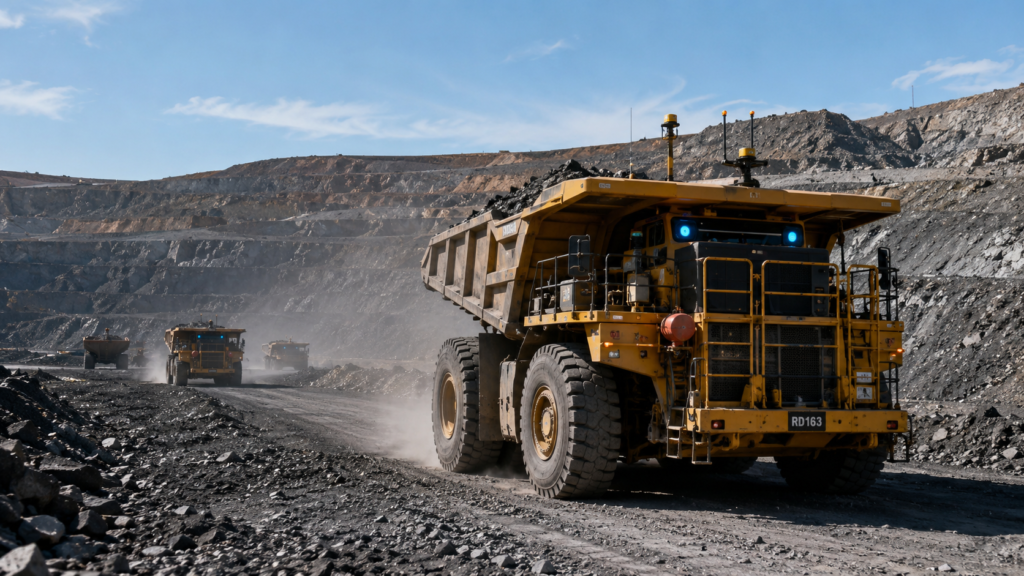
Walk into a modern mine, and you will see a lot of expensive equipment.
You will also see something less obvious. A surprising amount of that equipment spends time waiting.
A truck waits for a loader. A loader waits for trucks. A drill waits for blasting. A repaired machine waits for the next production window.
That lost time is becoming one of the biggest productivity questions facing Canadian mines.
The industry has spent years improving individual machines. Trucks carry more. Drills work with greater precision. Sensors capture more information. Autonomous systems can operate without someone sitting inside the cab.
Those advances matter. Yet a faster machine does not automatically make a faster mine.
The real opportunity sits in the spaces between activities.
The machine is rarely the whole problem
Take an underground haul cycle.
A truck loads at a drawpoint. It travels to the dump point, unloads, and returns. On paper, the calculation looks simple.
The actual shift is different.
The truck may wait for a loader. It may slow down because another vehicle occupies the ramp. It may reach the dump point when the crusher cannot accept more material. It may then lose more time during a shift change.
None of those problems require a better truck.
They require a better operating system.
This distinction matters because Canadian mines operate some of the most complex mining environments in the world. Many face deep ore bodies, long haul routes, remote locations, harsh weather, ageing infrastructure, and tight labour markets.
A mine cannot solve all of those pressures by buying more equipment.
It has to find where productive time disappears.
The best automation project may not look impressive
The mining industry naturally gravitates toward visible technology.
An autonomous truck makes a good headline. A remote operating centre does too.
Recovering 20 minutes of productive time from every shift does not sound as exciting. It can have a much bigger effect on the economics of an operation.
Agnico Eagle’s LaRonde operation gives us a useful example.
During the first half of 2026, around 25% of ore mucking used automated loaders. At LZ5, automated trucking reached roughly 2,030 tonnes per fully automated shift in June.
Those numbers show that automation is already producing measurable operating results.
Another figure deserves more attention. Agnico Eagle said optimisation work allowed about 10% of total production to take place between shifts.
That is where the story gets interesting.
The value did not come only from removing the operator from the machine. The operation also found productive time that its previous schedule could not use.
That is a much better way to judge automation.
Ask how many productive hours the technology creates. Do not ask how many machines have become autonomous.
The bottleneck can move
This is where mine planning gets difficult.
Suppose haulage limits production. The mine adds trucks and improves dispatch. Haulage capacity rises.
The problem may then move to the crusher.
If the crusher cannot handle the additional feed, the mine has increased its fleet cost without increasing saleable output.
The same thing can happen underground. A mine can improve drilling speed and then discover that blasting, mucking, or haulage cannot keep pace.
That is why the best operators study the whole production chain.
Drilling affects fragmentation. Fragmentation affects loading. Loading affects haulage. Haulage affects crushing.
Crushing affects grinding. Grinding affects recovery.
A change at the front of that chain can therefore create a problem at the back.
For Canadian mines, this mine-to-mill relationship deserves much more attention. A tonne moved through the mine has little value if the processing plant cannot turn it into recovered metal efficiently.
Better fragmentation can sometimes create more value than another truck. It can reduce oversize, smooth crusher feed, and make downstream processing more stable.
The important metric is not tonnes moved.
It is valuable output.
Autonomous fleets create a different problem
Autonomous equipment removes some forms of human variability.
It does not remove congestion.
In fact, consistent autonomous equipment can expose congestion more clearly.
Imagine ten trucks following highly predictable routes. They reach the same loading area within a narrow time window.
The loader cannot serve all ten at once.
The fleet has now created a queue with impressive precision.
That is why fleet orchestration matters. The system needs to decide which truck should move, where it should go, and when it should arrive.
Raglan Mine in Nunavik provides a strong Canadian example.
Glencore’s ConnectedMine initiative combines real-time data, connected equipment, analytics, automation, and autonomous systems. The operation has also demonstrated remote control over long distances.
The significance goes beyond autonomous driving.
Raglan can move some control functions away from the physical work area. That matters in a remote sub-Arctic operation where weather, distance, and logistics add another layer of difficulty.
It also creates new requirements. The mine now depends more heavily on communications, software, data quality, and technical support.
Automation changes the risk profile. It does not remove risk.
Electrification changes the bottleneck again
Battery-electric equipment introduces another constraint.
A diesel truck needs fuel. An electric truck needs power at the right time and in the right place.
That sounds like a simple difference. Underground, it is not.
A mine now needs to plan around battery state, charging time, route length, gradient, payload, temperature, and available electrical capacity.
Charging can become part of the production schedule.
NRCan’s Evolve project is testing battery-electric vehicles at multiple underground mines in Canada. The project aims to establish the business case for BEVs in brownfield operations. It is examining productivity, cost, charging, and equipment utilisation under real mining conditions.
That approach matters because laboratory performance does not tell an operator everything.
A mining vehicle may run continuously for hours. It climbs ramps, carries heavy loads, stops, accelerates, and regenerates energy during braking.
NRCan researchers are using AI to study exactly how batteries behave under these conditions. They are looking at energy consumption, regeneration, battery degradation, and performance over the vehicle’s working cycle.
This is where electrification becomes an operational issue rather than simply an environmental one.
The mine needs to know whether the electric fleet can deliver the required tonnes. It also needs to know whether charging will interfere with production.
Onaping Depth shows why the whole system matters
The Onaping Depth project at Glencore’s Craig Mine in Sudbury takes this discussion further.
The ore body sits nearly 2,600 metres below the surface. The project has just reached shaft completion and first access to the ore body. It is being developed around an all-electric underground fleet.
At that depth, diesel creates a second problem beyond fuel consumption.
It creates heat and exhaust.
The mine must move both out of the workings. That requires ventilation and cooling.
Glencore says the all-electric approach will reduce diesel emissions and lower ventilation and cooling requirements.
That changes the economics of the equipment decision.
The right comparison is not diesel truck versus electric truck.
It is the entire operating system required by each choice.
One option needs diesel logistics, exhaust control, ventilation, and cooling. The other needs charging infrastructure, electrical distribution, battery management, and new maintenance practices.
That is why deep mining makes electrification particularly interesting.
The machine is only one part of the calculation.
AI has to leave the dashboard
There is plenty of discussion about AI in mining.
Much of it focuses on prediction.
A system predicts a component failure. An operator receives an alert. Someone then decides what to do.
That has value.
The bigger opportunity comes when the system helps change the operation itself.
Imagine an electric truck approaching a charging window. The system knows its battery state, route, payload, and expected production demand.
It can compare those factors against the rest of the fleet.
It can then recommend a charging window that creates the least disruption.
That is optimisation.
The next step is automated control. The system changes dispatch or charging without waiting for someone to make the decision manually.
That requires far more trust in the data and the system.
NRCan’s current research shows why this stage remains difficult. Real-world data on electric mining vehicles remains limited, and battery behaviour varies over time and between vehicles.
AI can help fill that gap.
It cannot compensate for bad data.
Seven numbers should come before the next technology purchase
Before Canadian mines approve a major automation project, they should establish a simple operating baseline.
Equipment utilisation. How much available machine time produces useful work?
Queue time. How long do trucks, loaders, drills, and other assets wait?
Cycle-time variation. How much does performance change from one cycle to another?
Unplanned downtime. How much production disappears when equipment fails?
Shift-change losses. How much productive time disappears during handovers?
Energy per tonne. How much fuel or electricity does the operation use for useful output?
Constraint capacity. Which part of the operation currently limits production?
These numbers can change an investment decision completely.
A mine may think it needs another truck. The data may show that dispatching is the real problem.
Another operation may blame equipment reliability. The data may show that maintenance scheduling causes more lost production than mechanical failure.
A third may automate haulage and discover that the mill has become the new bottleneck.
That is not a technology failure.
It is a failure to understand the production system before making the investment.
The next productivity race will be about coordination
The strongest Canadian mines will not necessarily own the most autonomous equipment.
They will understand their constraints better.
Their geology teams will work closely with planners. Maintenance teams will see production priorities.
Fleet systems will account for processing limits. Charging systems will fit the production schedule.
That level of coordination sounds less dramatic than a fleet of autonomous trucks. It is also where the economics become much more interesting.
The industry has already started moving in this direction.
Canada is funding projects that combine electric vehicles with charging infrastructure. It is supporting work on mine ventilation, energy management, and digital mining technology. NRCan’s current investment list includes projects at Lalor, Westwood, Matawinie, and other Canadian operations.
These projects point toward a broader change.
Mining technology is no longer developing in separate lanes.
Electric equipment affects charging. Charging affects scheduling. Scheduling affects fleet utilisation.
Automation affects staffing. Remote operations affect communications. Digital systems affect how maintenance and production teams make decisions.
The mine of the next decade will have to manage all of those relationships.
That is the real productivity challenge.
The strongest Canadian mines will not be the ones that can say they have automated a truck, a drill, or a loader.
They will be the ones that can show what changed after the investment.
Did waiting time fall? Did utilisation rise?
Did energy use per tonne improve? Did downtime fall?
Did the mine recover more metal from the same ore?
Those are the numbers that matter.
The technology itself is secondary.
For mining leaders working through these questions, the 9th Canada Mining Operational Performance & Technology Summit takes place on 9–10 September 2026 at the Radisson Blu Toronto Downtown Hotel in Toronto, Canada. The event brings together mining leaders to discuss operational performance, equipment utilisation, automation, electrification, mine-to-plant optimisation, maintenance, and technology deployment.