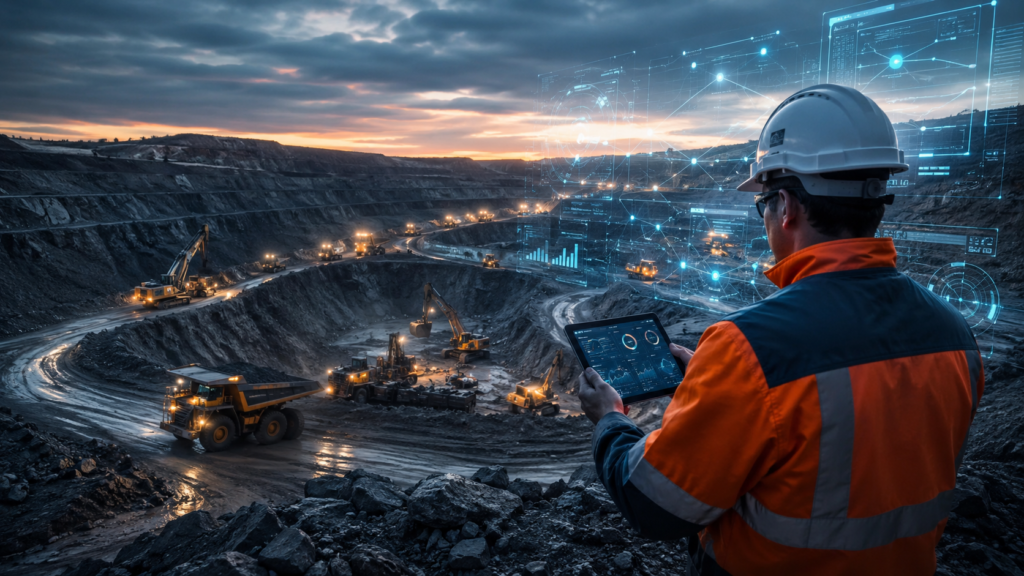
AI in Canada’s mining industry is moving beyond pilot projects/experimental programs. Today, mining firms apply AI to enhance output, minimize equipment downtime, improve worker safety, and accelerate operational decisions. As the global appetite for critical minerals continues to increase, Canadian miners need to produce more and do it more cost-effectively and in an environmentally sound manner.
The move appears to be at an important point in time. Mines throughout Canada are grappling with labour shortages, increasing costs of operations , and pressure to boost productivity. Meanwhile, investors and regulators anticipate better environmental performance. Thus, mining companies are adopting AI because it brings tangible business value. Whether it’s nickel operations in Sudbury and gold mines in Northern Ontario or uranium projects in Saskatchewan, AI is less an emerging technology and more a foundational element of everyday mining operations.
How AI in Canada’s Mining Industry Is Transforming Everyday Mine Operations
The impact of AI in Canada’s Mining Industry is not just automation. Rather, AI enables mining companies to make faster and more informed decisions based on massive amounts of operational data. Every phase of mining produces data, from exploration and drilling to transportation, processing, equipment maintenance, and environmental monitoring. AI processes this information live. As a result, operators increase efficiency, decrease operational risks, and make better decisions at every stage of the mining value chain.
Making Faster and More Accurate Operational Decisions
Every day, mining companies make thousands of decisions about their operations. These decisions have impacts on production, equipment usage, ore recovery, and operating expenses. In the past, much of that was based on historical reports and manual analysis. But AI can assess live operational information in a matter of seconds. It recognizes patterns, forecasts events, and suggests responses before minor interruptions propagate into production.
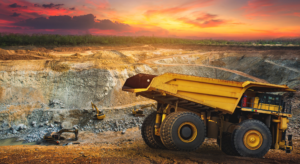
As one example, AI is assisting operators in determining the optimal ore grades for the material to mine and process. It also enhances production scheduling by dynamically modifying mining sequences in response to changing site conditions. At the same time, AI-enabled fleet management performs a joint analysis of haul routes, truck availability, fuel consumption, and production goals. As a result, mines cut downtime, boost equipment use, and increase throughput–with no new machinery.
Turning Operational Data into Predictive Action
Modern mining machinery constantly produces data on temperature, vibration, pressure, engine output, and component wear. AI in Canada’s Mining Industry enables you to turn this data into actionable maintenance insights. Rather than responding to equipment breakdowns, maintenance professionals are getting warnings that enable them to make repairs before the equipment can cause unplanned service and production disruptions.
In addition, predictive maintenance enables companies to plan repairs based on the actual condition of the equipment rather than according to predetermined service schedules. This strategy conserves critical assets without the need to perform unnecessary maintenance. Predictive analytics is now being used by Canadian mining firms to anticipate bust-up days in advance. The result is less downtime, longer equipment life, improved maintenance planning, and reduced operating costs without compromising production targets.
Improving Safety Without Slowing Production
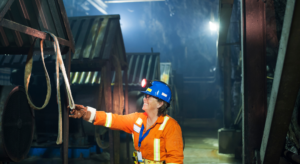
Safety continues to be a top concern of Canada’s mining industry. AI is enabling companies to enhance safety without compromising operational efficiency. Computer vision techniques are applied to work areas and are subjected to real-time monitoring. They can recognize people who enter restricted areas, detect unsafe vehicle and pedestrian interactions, and verify whether they are wearing protective gear properly.
AI also enhances environmental and geotechnical monitoring. It compiles data from ground movement sensors, weather stations, dust monitors, water quality systems, and tailings facilities. When the situation starts to deteriorate, the engineers are warned about it – not just when the risk has increased. So mining firms can react more quickly, protect workers, minimize environmental impacts, and maintain compliance while running their operations safely and effectively.
Why AI Investment Has Become a Competitive Necessity for Canadian Miners
AI implementation is not simply a technology decision. It’s now a business play that is increasingly crucial for mining companies to stay competitive in an evolving industry. Canada’s mining industry benefits from AI to increase productivity, reduce operating expenses, and enhance operational resiliency. Therefore, organizations that harness AI have the agility to respond quickly to changes in the market and to do so with improved enterprise-wide business performance.
The Business Pressures That Traditional Mining Can No Longer Solve
Canadian mining companies have a lot on their plate. Labour shortages are still being felt in the isolated mining areas, and fuel, machinery, and maintenance costs keep rising. And mines are grinding lower-grade ore at many sites. Companies have to process, haul, and crush more material to extract the same quantity of metal. Because of this, operational efficiency is a must-have, not a nice-to-have.
The old ways of decision-making in the mining industry cannot keep up. Mines are beginning to produce operational data – from machinery to processing plants to monitoring systems – at the scale of millions every day. Crowds of people cannot process that data fast enough to optimize every decision. But AI in the Canadian mining sector turns intricate data sets into actionable insights in a matter of minutes. Managers can use this knowledge to better plan production, predictively manage resources, and address operational challenges before they translate into expensive problems.
Why AI Supports Canada’s Long-Term Mining Strategy
Canada is positioning itself to be a world leader in the production of everything from electric vehicle components and renewable energy systems to semiconductors and advanced manufacturing. But production increases aren’t enough. They also need to be more efficient, less polluting, and more sustainable in their use of nature. AI application in Canadian mining is aligned with these policies by making operators more cost-effective in extracting valuable minerals and, in doing so, minimizing waste, energy consumption, and operating expenses.
And investors are increasingly assessing mining companies on environmental, social, and governance performance, in addition to financial results. AI enables better environmental tracking by measuring emissions, water use, energy consumption, and operational status in real-time. So firms can detect problems and fix them sooner. More reporting also means greater transparency with regulators, investors, customers, and local communities. So AI can help mining with both operational and strategic competitiveness.
What Will Separate AI Leaders from AI Followers in Canada’s Mining Industry?
The next stage of AI in Canada’s Mining Industry will be less about applying individual technologies and more about combining them into one cohesive operating system. Mining firms today already rely on sensors, automation, remote monitoring, and sophisticated software at many sites. However, those that link these technologies through AI will decide faster, collaborate better, and respond more effectively to shifting operating conditions.
Building Intelligent Mine Sites Instead of Connected Mine Sites
Already, many Canadian mines are generating vast amounts of operational data. Yet that kind of information is frequently siloed in separate systems. AI unifies these datasets to provide a comprehensive view of mine performance. This enables the operator to get a clear picture of the impact of decisions in one area on production, maintenance, energy use, and safety elsewhere in the enterprise.
Digital twins are the next stage in this evolution. They use real-time operational data to generate virtual models that replicate real mining operations. Engineers can simulate production schedules, forecast the performance of equipment, and analyze operational modifications before making them in the field. At the same time, edge computing is processing data near the equipment instead of ferrying everything away to remote data centers. As a result, mines get real-time insights and respond right away to evolving conditions, even from remote sites in Northern Ontario and Saskatchewan.
The Leadership Skills the Next Generation of Mines Will Need
The future of AI in Canada’s mining sector will not be determined by technology alone. Mining companies require leaders who can operationalize the business and have a deep knowledge of operations, digital technologies, and data-driven decision-making. AI should enable seasoned experts, not substitute for them. It still takes people to understand results, to manage risk, and to make complicated operational decisions.
As a result, workforce development is just as critical as the technology investment. Companies also need to educate engineers, geologists, maintenance crews, and mine bosses to trust and work with AI-based systems. Strong governance will also be key. Well-defined policies on data quality, cybersecurity, model validation, and responsible use of AI will enable organisations to build trust and maximize value in the long term from their digital investments.
To Sum Up
The use of AI in Canada’s Mining Industry is changing the way mines operate, compete, and grow. It enables faster decision-making, increases worker productivity, and enhances worker safety and environmental performance. But more than that, it makes it easier for Canadian miners to ramp up to meet increasing demand for critical minerals, while being more efficient and responsible. The long-tail benefits include better outcomes for patients and consumers, and significantly improved economics and efficiency for companies developing and commercializing new medicines. These priorities will be the focus of the 9th Canada Mining Operational Performance & Technology Summit in Toronto, Canada, on 9–10 September 2026, as industry leaders discuss the technologies and strategies shaping the future of Canadian mining.